Archive
Monthly Archives: April 2020
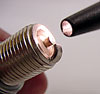
If you were to give the same engine to 10 different racers how many different results would you have? 10! I’ve seen it first hand, some racers are just better than others at getting the most out of their combination.
Me, I’ve never had the most money so I’ve had to learn how to tune.
At RacingSecrets.com we’ve been selling a spark plug inspection light for a couple of years now. We’ve always wanted to create a video to go along with it, but never had the time. Well, it’s finally done.
There is no other product like it on the market — at any price. Please read the full product descriptions below. Also, for the past few months we’ve been
Spark Plug Reading Kit
Creator: RacingSecrets.com
Includes – (Plug Light & Video)
What the VIDEO will teach you:
How NOT to Read Plugs
Reading the Porcelain
Reading the Ground Strap
Reading the Center Electrode
Gapping
Indexing
Conclusion
KIT CONTENTS:
Inspection Light
|
Instructional Video (Included with both lights)
What people are saying about the VIDEO:
“This video absolutely debunks traditional views of spark plug analysis. Never seen anything like this in all the articles, magazines and books.”
J.T. Thannum
Germantown, TN
“The amount of knowledge I gathered about heat ranges of plugs, jetting of carburetors and checking for proper timing is priceless.”
F.D. Deitch
Clarington, OH
“The video condenses years of blood, sweat, tears and mistakes.”
R.D. Leigh
Witt, IL
“I would recommend this video to anyone wanting to get the most out of an engine”
Ron Streigle
Anaheim, CA
“If you think you know how to read a plug, you need to buy this video, thinking it, doesn’t make it so.”
Arnie Henrickson
Lacey, WA
“I can now rely on looking at plugs to judge the tune of my engine.”
T. Lemenager
Ashkum, IL
“I was really shocked when I looked at my first spark plug. I wish I would have had access to this 10 years ago.”
Toby Miller
Nappanee, IN
The Horsepower Chain –
Racing Engines Optimized Through Hardcore Math
The 4 stroke internal combustion engine first ran in 1876. This engine design, known as the Otto cycle, has been thought of as having the following strokes – intake, compression, expansion and exhaust. This design is used in the vast majority of racing engines today. Engine builders, and racers alike, think about improving the performance of their engines using this 4 stroke approach, or what I prefer to call the “old 4 process.”
Sometimes people focus on the 4 critical camshaft timing events – intake valve opening (IVO), exhaust valve closing (EVC), intake valve closing (IVC), and exhaust valve opening (EVO) to characterize engine performance. This was a good step forward, but a finer breakdown is needed to really understand racing engines.
Instead of the traditional 4 strokes, the modern high performance engine should be thought of as having 7 distinct individual processes. This “7 process” approach focuses on air flow through the engine and is a result of two decades of research while developing the worlds most popular racing engine software — Quarter Jr’s “Engine Pro”
The New 7 Process Model:
These 7 processes are linked together and affect each other in turn. In other words, the output from one process defines the input for the next. It follows logically that each of these 7 processes must be fully optimized in order to achieve the highest engine performance possible.
However, the overall engine is only as good as the weakest link in this chain of processes. Some changes may well improve one process, but hurt another. Identifying which of these 7 processes is holding the engine back is key to improving your engine’s performance.
The physics behind each of these 7 processes is very different. All we can adjust/change is the shape of the components that make up the engine. What is the absolute best combination of components? How do we find that best combination without just throwing parts at the engine?
Announcing: “The Horsepower Chain – Racing engines explained through hardcore math”
About the Book:

![]()

![]()
